Little Orpheus
Birds stopped singing, rivers paused, rocks danced. Even death lessened its severity, so the lyre could be heard in a silent land.

Some years ago, this was published on Story Warren with an illustration by Jamin Still. I found it recently and had to polish it up: my illustrations aren’t Still-worthy – but practice toward doing better is good for the soul. (And such as they are, they are what I eeked out of silence lately — so if you’d like a card in the mail with one of these, let me know.)
All that his unquelled grief bestowed,
and love, that doubles grief
-Boethius
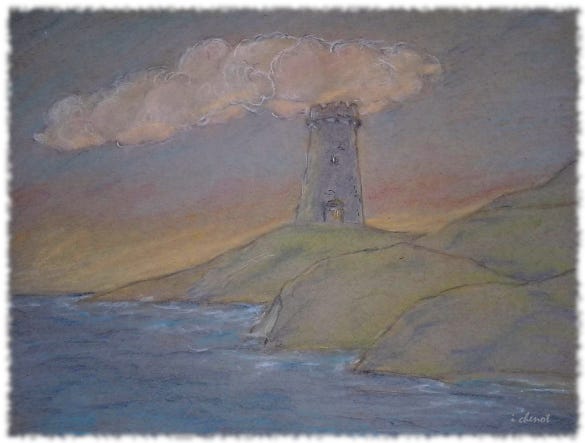
In a tower, in a village, in a kingdom by the sea, was a lyre unlike any other. Over the door of the tower were ancient words:
As sorrow walls the listener
this tower walls the stars
till hands that shake the prisoner
awake th-
The rest of the letters were worn away by ice, snow, and rain.
The lyre was strange and roughened, with coarse strings. It could not be tuned, and striking the strings was painful to the fingers and the ears. People said its maker could play so beautifully that animals would follow him. Birds stopped singing, rivers paused, rocks danced. Even death lessened its severity, so the lyre could be heard in a silent land. No one else ever knew how to play it.
To this village came a child – no one knew how. He was found beside a hut belonging to an old woman. She took him inside, wrapped him up, fed him, and rocked him to sleep. She sang:
Beggar child who might have been a king,
ask me for bread, a warm place by the fire, a bed.
Though I have scarcely anything,
you will have half of all the tears I shed
and all the songs I sing.
As the child grew, the old woman sang other songs, but he could not sing with her – he was mute. He watched other children open their mouths, and fill the air with sounds. His mouth was empty. But he had magic hands.
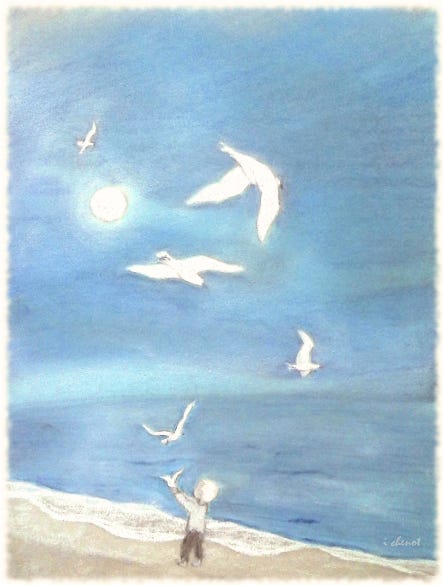
They looked like everyone else’s till he cupped them in the sea. Then fish would dart out, tickling his fingers. When he cupped them in air, they were filled with fluttering till white birds flew away – in the grass, little creatures with trembly whiskers would scurry out.

He was a maker – like the lyre-maker, the villagers said. They read the words on the tower, and told the story of the lyre:
Long ago a snake bit the lyre-maker’s bride, and dragged her to the underworld. He traveled to the underworld after her, playing his lyre. The ruler of that shadowy place was so moved by the song that he let the lyre-maker lead his bride back to light. Only, the maker must not look at her until they reached the upper realm, or she would vanish away a second time.
Light was just breaking over them from the upper realm, when the lyre-maker turned. His bride vanished, and that was why no one could play the lyre. The maker ruined it with grief.
Sometimes the boy went into the tower and touched the lyre that had shaken shadows. But even his magic hands could not draw music from it. Whatever the strange, rough lyre was made of – it was not air, sea, or earth. When he touched its strings, his hands were empty.
The child’s own story was told throughout the kingdom; and after he had been with the old woman five or six years, the king took him away to a city with a castle. He slept in a room by a garden, where lords and ladies came to see his magic hands held in the air till birds flew from them, or in a brook till fins flashed from his fingers. He longed to hold his hands in something that would fill them with words – sounds fluttering like wings, till he flew out of himself.
The ladies who came to the castle garden wanted to make pets of his creatures. Two birds were caught, and a cage was made for them by the king’s carpenter. He carved it whole from a large tree. Only the hinges and latch of the door were carved separately. Though he was mute, the boy understood his creatures; and since his own tongue imprisoned him, he especially understood the caged birds.
One day, there was a fire. Lords and ladies, servants and soldiers scurried from the flaming castle like bunnies or voles from his fingers; but the boy pushed past them, rushing in. His birds were trapped.
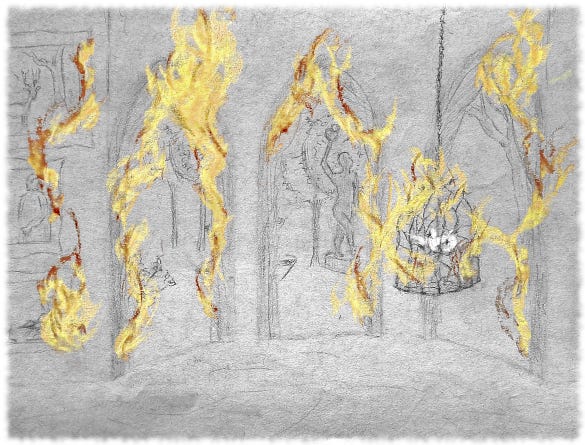
Many furnishings in the castle had taken fire, and the birds were singing on their perch in a cage of flame. The boy unlatched the door and reached in to draw both birds out, but only one of them flew free.
That is how he lost the magic in his hands. They were scarred afterward: when he held them in air, in the brook, or in the grass, they were empty – as empty as his lips that could not form words. And that is how he flew free. The king sent him back to the village by the sea.
The old woman now lay ill. She did not recognize him, and he could not sing any of her songs to bring remembrance. He could only share half of her tears.
One evening as he walked near the tower, the words above the door caught the day’s last glow:
As sorrow walls the listener
this tower walls the stars
till hands that shake the prisoner
awake th-
He went in and stood by the lyre. He was no longer a maker; and he had not drawn music from the lyre when his hands were whole. But it reminded him of the birdcage in the castle, and he touched one of its coarse strings. A clear note sounded – like a fragment of birdsong. He touched another string; and there was a small, shining note like a star. He touched two strings together: they were like two birds singing in a flame.
He stilled the vibrating strings, till they were as still as thinly carved bars. And suddenly he understood the secret of the lyre. It was not water, or air, or earth. It was pain. To turn it to music, he had to reach into a burning cage, and draw out a bird.
As he played, villagers arose from their firesides to stand in their open doors. Home-light spilled around them while they looked up at the stars.
In her hut, the old woman sat up and thought heaven looked strangely beautiful. As though the sky were full of white birds flying to her window, singing to her.
~About Boethius
Early in the 6th century, a brilliant Christian theologian, philosopher, and statesman named Boethius was accused of treason, and condemned to be beaten to death. While he was waiting in prison for his sentence to be carried out, he wrote a story of how Philosophy – a tall, regal woman – came to comfort him.
She sang a song that retold an ancient myth: the Greek story of Orpheus, who played the lyre so beautifully, and who traveled to the underworld to reclaim Eurydice, his bride. Philosophy sang of how Orpheus drew on all his depths of grief and love to play his lyre in the underworld. The quotation at the beginning of this story is taken from her song. She explained that we are all like Orpheus, trying to lead our minds to light.
After his death, Boethius’ book, The Consolation of Philosophy, became one of the most important books in history.
Beautiful! And the lovely, ethereal artwork fits perfectly.
Orpheus’s story was always my favorite from Greek myth. :)
Lovely story.